🎥 Watch this quick video explanation before reading the detailed guide.
Introduction to Bridge Rectifier
In modern electronics, almost every device depends on a stable and reliable power supply. However, the electricity we receive in our homes is in the form of Alternating Current (AC), while most electronic devices operate on Direct Current (DC). This is where a very important electronic device called a Rectifier comes into use.
A Bridge Rectifier is one of the most widely used rectifiers in electronics. It converts AC into DC efficiently and is used in devices like mobile chargers, power supplies, televisions, computers, and many industrial systems.
This article provides a complete understanding of the construction, working, circuit diagram, advantages, comparison, and applications of a bridge rectifier in simple and easy language.
What is a Rectifier?
A rectifier is an electrical device that converts Alternating Current (AC) into Direct Current (DC). Since most electronic circuits require DC power, rectifiers are essential components in power supply systems.
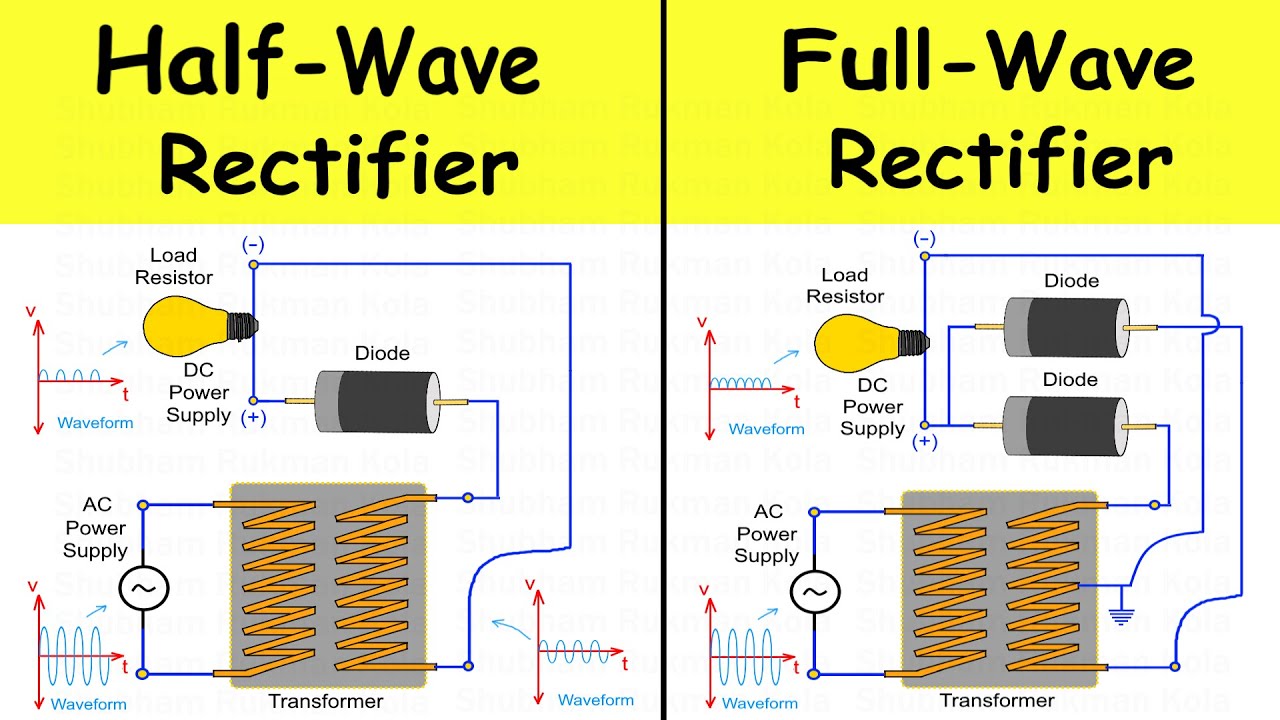
- Half-Wave Rectifier
- Full-Wave Rectifier (Center Tap)
- Bridge Rectifier
Among these, the bridge rectifier is the most efficient and widely used.
What is a Bridge Rectifier?
A Bridge Rectifier is a type of full-wave rectifier that uses four diodes arranged in a bridge configuration to convert both halves of AC input into DC output.
Unlike center-tap rectifiers, it does not require a center-tap transformer, which makes it simpler and more cost-effective.
Construction of Bridge Rectifier
1. Transformer
A step-down transformer is used to reduce high AC voltage to a lower and safer level suitable for electronic circuits.
2. Four Diodes (D1, D2, D3, D4)
Four diodes are connected in a bridge form. These diodes control the direction of current flow and convert AC into DC.
3. Load Resistor (RL)
The load resistor is connected across the output terminals. It receives the rectified DC voltage.
4. Capacitor Filter (Optional)
A capacitor is often added to smooth the pulsating DC output and make it more stable.
Working of Bridge Rectifier
Positive Half Cycle
- Diodes D1 and D3 become forward biased and conduct current.
- Diodes D2 and D4 become reverse biased and block current.
- Current flows through the load in one direction.
Negative Half Cycle
- Diodes D2 and D4 conduct current.
- Diodes D1 and D3 block current.
- Current again flows in the same direction through the load.
Thus, both halves of AC are converted into DC, resulting in a continuous output.
Output of Bridge Rectifier
The output of a bridge rectifier is not perfectly smooth. It is called Pulsating DC. To make it smoother, a capacitor filter is used.
Comparison Table: Bridge Rectifier vs Other Rectifiers
| Feature | Bridge Rectifier | Half-Wave Rectifier | Center-Tap Rectifier |
|---|---|---|---|
| Efficiency | High | Low | Medium |
| Number of Diodes | 4 | 1 | 2 |
| Transformer | No Center Tap Required | Not Required | Center Tap Required |
| Output | Full Wave DC | Half Wave DC | Full Wave DC |
| Ripple | Low | High | Medium |
Advantages of Bridge Rectifier
- High Efficiency: Uses both halves of AC cycle.
- No Center Tap Needed: Simplifies transformer design.
- Better Output: Produces more continuous DC.
- Cost Effective: Widely used and affordable.
- Suitable for High Power: Works well in industrial applications.
Disadvantages of Bridge Rectifier
- Uses more diodes compared to half-wave rectifier.
- Voltage drop across diodes reduces output slightly.
- Output still contains ripple without filter.
Applications of Bridge Rectifier
1. Power Supplies
Used in mobile chargers, laptops, and adapters.
2. Battery Charging
Used in UPS systems and inverters.
3. Consumer Electronics
Used in TVs, radios, and computers.
4. Industrial Applications
Used in welding machines and motor drives.
5. DC Motor Drives
Provides stable DC supply for industrial motors.
Market and Industry Trends
The demand for efficient power conversion systems is rapidly increasing due to the growth of electronics, renewable energy, and electric vehicles.
- Power Electronics Growth: Increasing demand in EVs and solar systems.
- Miniaturization: Smaller and efficient rectifier modules.
- Smart Devices: Increased use in IoT and embedded systems.
- Industrial Automation: Growing use in robotics and control systems.
Bridge rectifiers remain a key component in modern power electronics due to their simplicity and reliability.
Conclusion
The bridge rectifier is one of the most important components in electronics. It efficiently converts AC into DC and is used in almost every electronic device. Understanding its construction and working helps in designing better circuits and power systems.
From small gadgets to large industrial machines, the bridge rectifier plays a vital role in ensuring smooth and stable operation.
Frequently Asked Questions (FAQ)
Watch the Full Tutorial above for a complete visual explanation.
![Junction Field Effect Transistor [JFET] Explained: Construction, Working, Application | Shubham Kola](https://shubhamkola.com/wp-content/uploads/2026/04/Junction-Field-Effect-Transistor-JFET-Explained-Construction-Working-Application-Shubham-Kola.jpeg)